


Raleigh Hills Oregon History | Broadmoor's Historic Farmhouse

Raleigh Hills Oregon - The History Hidden Behind a Neighborhood
My first real estate office in 2001 was in the Raleigh Hills and now I live in the area. On my daily walks I've strolled past a particular home on SW Maple Drive many times.
It's always caught my attention.
Sitting slightly above the street, with its covered front porch and distinctly older architecture, 7985 SW Maple Drive looks different from many of the homes surrounding it.

I've often walked past wondering what it looked like inside, and perhaps even more interestingly, what its history was.
Recently, I finally had the opportunity to find out.
The home came on the market, and I toured it during a Brokers Open.
The listing describes it as “Broadmoor's Historic Farmhouse.” Inside, the character that had intrigued me from the street was still there. The Farmhouse has original and reclaimed Red Oak and Douglas Fir floors, extensive millwork and built-ins, all incorporated into a home that has also undergone substantial modern renovations.
7985 SW MAPLE DR Portland, OR 97225 - $799,000
Listed by Jonathan Ziegler & Connie Apa of ELEETE Real Estate
Updated Kitchen
But walking through the house made me even more curious.
This farmhouse was built in 1946 - how did it fit into the history of Raleigh Hills?
So I started digging.
I searched Washington County records, historical maps and eventually found the original Broadmoor subdivision plat.

What I discovered was more interesting than I expected.
According to Washington County tax information, the house was indeed built in 1940.
But the original Broadmoor subdivision plat is dated 1946.
In other words:
The farmhouse appears to predate Broadmoor itself by six years.
And that immediately raised another question:
What Was Here Before Broadmoor?
To answer that, we need to go backward.
Not just six years.
More than a century.
Before Raleigh Hills Had a Name
Long before there was a Raleigh Hills, Broadmoor, Beaverton-Hillsdale Highway or Portland as we know it, the greater Tualatin Valley was home to the Tualatin people, also known as the Atfalati, a Northern Kalapuyan people.
The Tualatin lived in villages across the Tualatin Plains and surrounding valleys. The landscape provided roots, berries, fish and game, and Indigenous land-management practices, including controlled burning, helped maintain portions of the valley's open grasslands and oak savannas.
That landscape would later prove attractive to Euro American settlers because of the same characteristics that had been maintained and utilized by Indigenous people for generations: open land, productive soil and access to natural resources.
Disease devastated Native populations before large scale Euro American settlement. Following the Willamette Valley Treaty of 1855, Indigenous peoples of the region were removed from their ancestral lands to the Grand Ronde Reservation.
By the middle of the nineteenth century, settlers were establishing farms throughout Washington County and the Tualatin Valley.
And among them was a family whose name would eventually become attached to this community.
Who Was Raleigh?
Raleigh Hills appears to take its name from Raleigh Robinson, whose family was among the early settlers of Washington County.
His parents, William J. and Emeline Robinson, came west and established themselves in Washington County in the nineteenth century.
Raleigh Robinson was born in Washington County in 1857 and grew up in the area.
By the late nineteenth century, “Raleigh” had become enough of an identifiable community to have its own post office.
The Raleigh post office opened in April 1892 and remained in operation for approximately twelve years.
That same year another Raleigh institution appeared that still exists today.
Raleigh School - 1892
Raleigh School began serving local families in 1892 from a white frame schoolhouse.
At the time, this was still very much a rural community.
The school operated as its own district, Raleigh School District #95 and originally served children through eighth grade.


A brick school building was constructed in 1927.
One detail from the school's own history gives us a wonderful sense of just how rural Raleigh remained: even during the 1940s, dairies surrounded the school, and some students were allowed to walk to a nearby dairy and milk cows.
That is difficult to imagine when driving through Raleigh Hills today.
But the transformation from countryside to suburb was still underway.
Raleigh Gets Connected to Portland
Another major change arrived in 1914.
That year, Southern Pacific's Red Electric interurban railway began serving Raleigh.
The Red Electric Red Electric Route Map Forest Grove Red Electric Station
The Red Electric connected Portland with communities west and southwest of the city and gave residents of places like Raleigh another way to travel between the countryside and Portland.
For a rural community, transportation mattered enormously.
Rail connections made it easier to reach jobs, businesses and services in Portland while still living outside the city.
Red Electric service through Raleigh continued until 1929.
But while trains were connecting Raleigh to Portland, something else was happening nearby that would eventually lead us back to that farmhouse on Maple Drive.
From Farmland to Fairways
Before Broadmoor and much of the surrounding residential development, large portions of the land between Raleigh Hills and Beaverton were agricultural.
Much of it had belonged to the Ladd and Reed Farm Company, which used the area's fields to grow feed for cattle and horses.
Then came the golf boom of the 1920s.
In 1924, the Multnomah Amateur Athletic Club purchased approximately 225 acres from Ladd and Reed to develop a golf course.

On June 13, 1925, the Multnomah Golf Club officially opened.

And this wasn't a small neighborhood course.
It was an 18-hole championship course designed by William J. Locke of San Francisco.
The fairways extended across a large portion of what would eventually become residential Raleigh Hills, reaching north toward Canyon Road, south toward today's White Pine Lane and west beyond today's 87th Avenue.

When the course first opened, an existing farmhouse on the property was even used temporarily as its clubhouse before a new clubhouse designed by prominent Portland architect Morris H. Whitehouse opened in 1926.
For roughly a decade, this part of Raleigh Hills wasn't a subdivision.
It was a golf destination.
The Great Depression Changes the Landscape
The timing was unfortunate.
The Multnomah Golf Club had opened during the prosperity and golf enthusiasm of the 1920s.
Then came the Great Depression.
By the early 1930s, the club was struggling financially. Membership promotions and reduced expenses weren't enough to overcome the economic conditions.
In 1935, after only about a decade of operation, the Multnomah Golf Club closed and consolidated with the Lake Oswego Country Club.
The golf course disappeared as a functioning club.
But the land remained.
And that brings us back to the house that started this entire investigation.
Broadmoor's “Historic Farmhouse”
The home at 7985 SW Maple Drive is recorded as having been built in 1940.
That's only about five years after the Multnomah Golf Club closed.
But Broadmoor still didn't exist.
When I searched Washington County's historical records, I found the original Broadmoor subdivision plat.
It is dated 1946.
The document identifies Victory Homes, Inc., an Oregon corporation, as the owner responsible for platting the property into lots, blocks and streets under the name:
BROADMOOR
The home now known as 7985 SW Maple would ultimately sit within the subdivision as Broadmoor, Block 3, Lot 32.
So we have a fascinating sequence:
1925 - Multnomah Golf Club opens
1935 - Multnomah Golf Club closes
1940 - 7985 SW Maple is recorded as built
1946 - Broadmoor is formally platted
That places the farmhouse in an intriguing window in Raleigh Hills history.
It was built after the golf club closed but before Broadmoor was formally created.
What We Know - And What We Don't
Historical research has a way of creating new questions almost as quickly as it answers old ones.
We know the recorded construction date of the house.
We know when the golf club operated.
And we have the original 1946 Broadmoor plat.
What we haven't established is who originally built the house, exactly how its parcel was configured in 1940, or whether that particular piece of land had previously been part of the Multnomah Golf Club property.
Answering those questions would require going farther into historical deeds, tax rolls and pre-Broadmoor property records.
What the records do reveal is compelling enough:
The farmhouse appears to come from the transitional period between Raleigh Hills' golf-course era and the creation of the Broadmoor neighborhood.
And that makes it a tangible reminder of how quickly this landscape was changing.
Broadmoor Begins to Take Shape
The original 1946 plat gives us a snapshot of a neighborhood being created.
Roads and residential lots replaced the larger tracts of land that had characterized the area.
Maple Drive, Laurel Avenue and Broadmoor Terrace appear on the plat, along with the original blocks and lots of the new subdivision.
Later development expanded outward.
Washington County's section maps show Broadmoor, Broadmoor-2, Broadmoor-3 and Broadmoor-4, alongside neighboring developments including Brentwood, Raleighwood and Raleigh Highlands.
What had once been farmland and open countryside and, for a brief period, a golf course, was becoming suburban Portland.
The Postwar Transformation of Raleigh Hills
Broadmoor was part of a much larger transformation occurring throughout Raleigh Hills and Washington County following World War II.
Portland's metropolitan population was expanding.
Automobile ownership was increasing.
Families were looking beyond the older neighborhoods close to downtown for places to buy homes.

And Washington County had something developers needed:
Land.
Former farms and large properties were increasingly divided into residential neighborhoods.
Beaverton-Hillsdale Highway and Scholls Ferry Road provided important connections between the growing suburbs, Beaverton and Portland.
Unlike Portland's older streetcar neighborhoods, much of Raleigh Hills developed around the automobile.
That history remains visible in the neighborhood today.
Curving residential streets follow the area's rolling terrain. Homes often sit on larger lots.
Mature trees and established landscaping create a distinctly different feeling from Portland's more densely developed inner neighborhoods.
And the architecture tells the story as well.
The Mid-Century Architecture of Raleigh Hills
Walk through Raleigh Hills and you'll encounter an interesting mixture of residential architecture.
There are older homes such as the farmhouse on Maple Drive.
But much of the neighborhood reflects the building boom of the 1940s, 1950s and 1960s.
Ranch homes became particularly popular.

1950 Mid-Century built by W.C. Bauman.
Their broad rooflines, single-story layouts, attached garages and connection to outdoor spaces represented a new vision of suburban living.
You'll also find mid-century modern homes incorporating large windows, open interiors and designs that respond to the area's wooded and sloping terrain.
Split-level homes offered another solution for building on Raleigh Hills' rolling landscape.
1964 Split Level 1964 Split Level 
1964 Split Level
The result is a neighborhood where the architecture often changes from one street or even one house to the next.
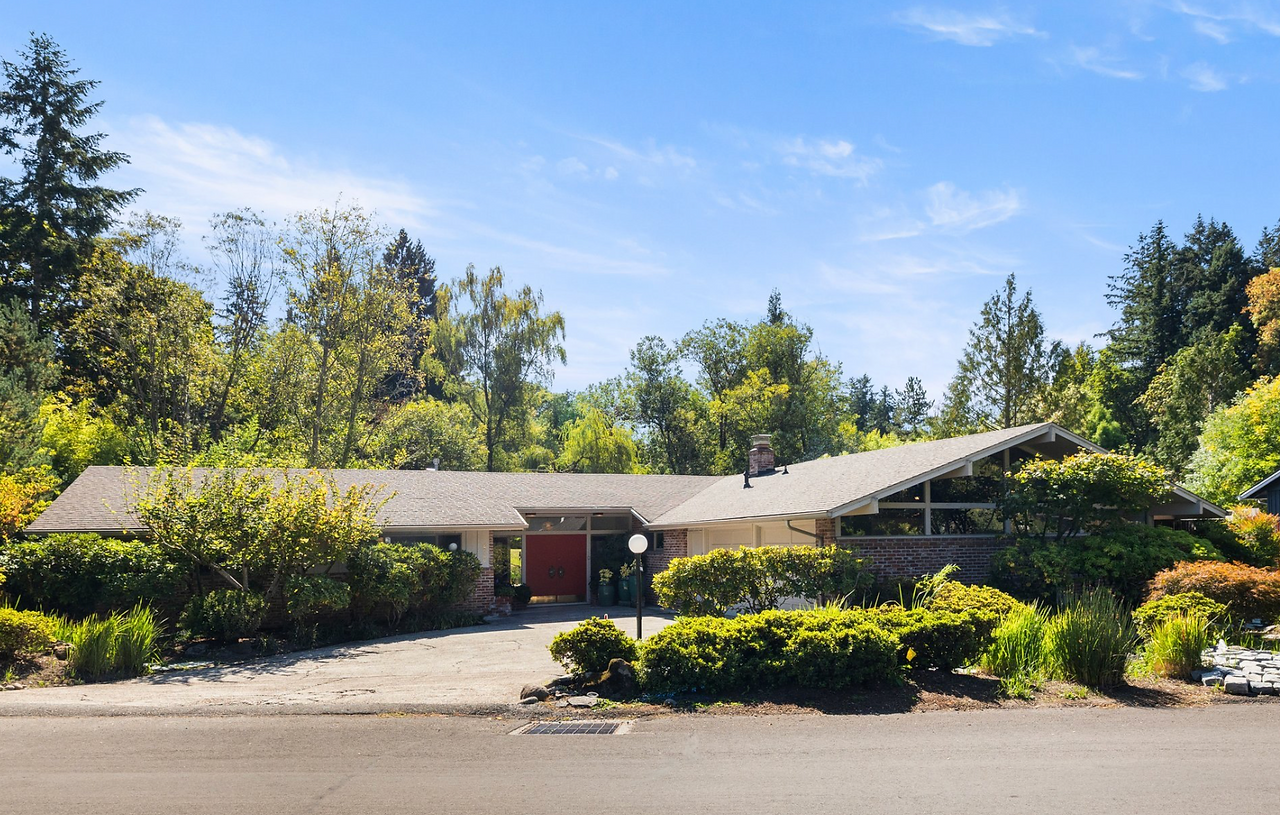
1958 Mid-Century Modern on Raleighwood Lane
And that's part of what makes Raleigh Hills interesting.
It wasn't created by a single developer at a single moment.
It evolved.
Raleigh Hills Today
Today, Raleigh Hills occupies a unique position within the Portland metropolitan area.
It sits between Portland and Beaverton but remains an unincorporated community in Washington County.
Its commercial heart developed around the intersection of Beaverton-Hillsdale Highway and Scholls Ferry Road, while established residential neighborhoods spread into the surrounding hills.
The farms and dairies that once defined the landscape are gone.
The Red Electric no longer stops here.
The Multnomah Golf Club has disappeared beneath streets, parks, schools and homes.
But traces of each era remain.
Sometimes they're found in historical maps.
Sometimes they're visible in the route of an old road.
Sometimes they're hiding beneath a modern neighborhood.
And sometimes they're standing right in front of you.
Back to the Farmhouse on Maple Drive
Now when I walk past 7985 SW Maple Drive, I see it differently.
For a long time, it was simply that interesting old house I passed on my walks the one that made me wonder what it looked like inside.
Then I finally walked through the front door.
That experience led me to Washington County records, an original 1946 subdivision plat, the remains of a forgotten golf course, an old electric railway and ultimately more than a century of Raleigh Hills history.
The house itself doesn't tell us every answer.
We still don't know exactly who built it in 1940 or precisely how that parcel fits into the former golf course property.
But perhaps that's part of what makes neighborhood history so interesting.
Every house occupies a piece of land that had a story before the house arrived.
Every neighborhood had a landscape before its streets were drawn.
And the places we walk past every day can sometimes provide the doorway into discovering those stories.
That's one of the things I love about real estate and about learning the history of the communities where we live.
Sometimes discovering the history of an entire neighborhood begins with walking past one house and asking a very simple question:
I wonder what was here before?
Thinking About Raleigh Hills Real Estate?
Understanding a neighborhood means looking beyond today's listings and sales.
Its architecture, development patterns, streets and even individual homes can tell us something about how the community became the place it is today.
If you're thinking about buying or selling a home in Raleigh Hills or simply have a question about the local real estate market I'd be happy to help.
Dean Carver | Real Estate Broker
Data Driven. Client Focused.
When it's time to make your next move, I'd love the opportunity to be your real estate broker.


Comments